HOW TO DISTINGUISH ARABICA AND ROBUSTA COFFEE
HOW TO DISTINGUISH ARABICA AND ROBUSTA COFFEE
HOW TO DISTINGUISH ARABICA AND ROBUSTA COFFEE
HOW TO DISTINGUISH ARABICA AND ROBUSTA COFFEE
HOW TO DISTINGUISH ARABICA AND ROBUSTA COFFEE
HOW TO DISTINGUISH ARABICA AND ROBUSTA COFFEE


HOW TO DISTINGUISH ARABICA AND ROBUSTA COFFEE
HOW TO DISTINGUISH ARABICA AND ROBUSTA COFFEE
Arabica and Robusta?
There are more than 120 coffee varieties in the world, but there are only two that appear in your daily cup of coffee. Coffea arabica, abbreviated as Arabica, and Coffea canephora, also known as Robusta. At first glance, the appearance of the two types of coffee may seem similar, but don't be confused!
In fact, the biological structure and chemical composition of these two coffee lines have many differences. This is what creates the characteristic flavors of the two coffee lines. While Arabica exudes a sweet taste, with a little sourness from the fruit, Robusta is richer and more bitter due to its high caffeine content.
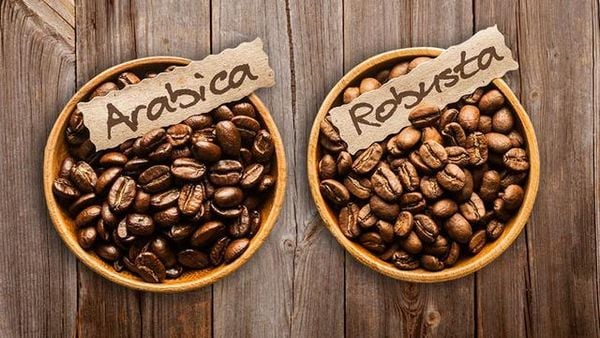
The two Arabica and Robusta lines respectively account for 60% (Arabica) and 40% (Robusta) of the world coffee market.
Origin and distribution
Although Robusta is often called the “ugly cousin” of Arabica, recent studies have shown that Robusta is actually the “parent” of Arabica. Through in-depth genetic analysis, scientists have discovered that Arabica was born after Robusta crossed with a coffee variety called Coffea euginoides.(*)
Currently, coffee is widely grown in many countries in the “coffee belt”.
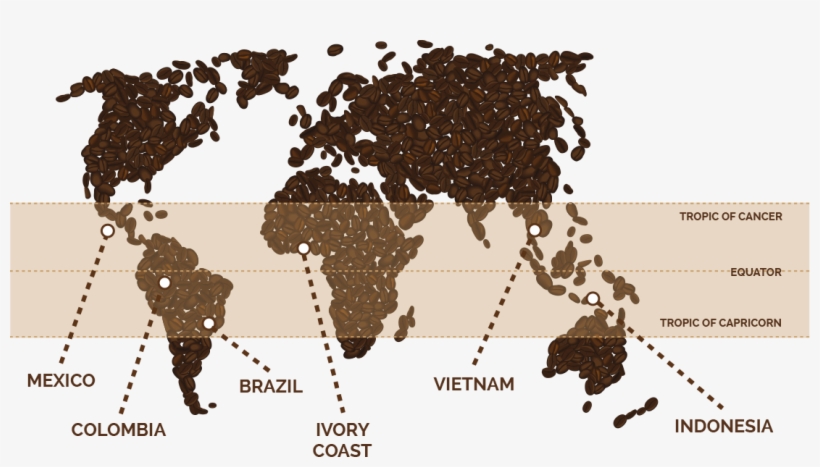
The “coffee belt” is the area between 23 degrees north and 23 degrees south latitude, which is the optimal area for coffee growth
Most Robusta coffee is grown in Central and Western Africa and some regions in Southeast Asia such as India, Indonesia and Vietnam. Arabica is grown mainly in Eastern Africa as well as Central and South America.
Plant characteristics
Coffee plants are evergreen all year round, growing in bushes or tall trees. The tree is usually pruned to maintain a height of about 1.5m. Pruning and keeping the coffee tree at this height is to support the most effective coffee harvest, because the coffee fruit matures at different times of the year, so harvesting is done by hand to ensure that the coffee fruit is selected at the right ripe stage.
Differences between Arabica and Robusta coffee trees:
Robusta trees are usually larger, reaching a height of 10 - 12m and covering a range of 3 - 4m. The yield of Robusta trees is about 1 - 5kg / season, twice as much as that of Arabica trees.
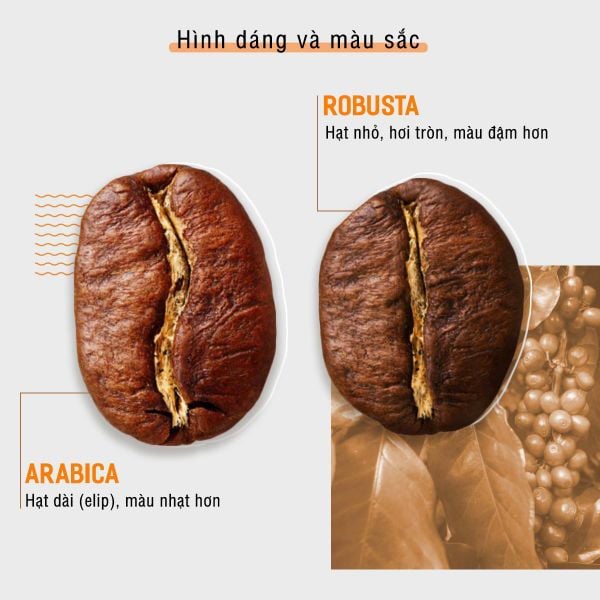
The most obvious feature to distinguish Arabica and Robusta is to look at their coffee fruits. Basically, Arabica fruits are larger with longer and wider fruit clusters than Robusta. Arabica coffee beans have deep, S-shaped grooves, while Robusta coffee beans have straighter and shallower grooves.
Suitable environment and climate:
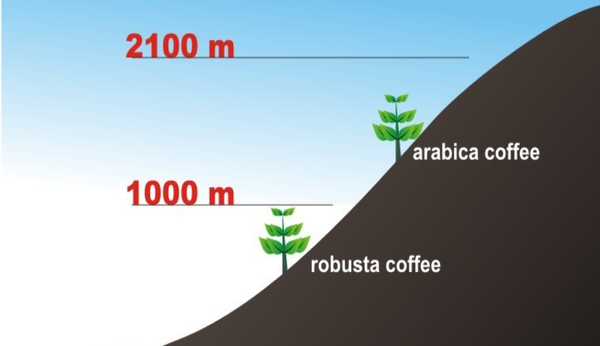
In general, coffee trees prefer temperate climates with high humidity and are very sensitive to sudden temperature changes. Because of these characteristics, coffee trees are only grown in tropical and subtropical regions. Robusta trees, which are more durable in nature, can be grown at an altitude of 900m above sea level with an ambient temperature of 20-30oC.
On the other hand, Arabica trees are more fragile and can only survive in highlands with an altitude of 900 - 2000m above sea level. Besides stable altitude and climate, Arabica trees need a humid environment, especially during the rainy season, to determine flowering and fruiting. However, too much rain or thunderstorms will damage coffee flowers and fruits.
Comparing Arabica and Robusta coffee
Chemical composition and flavor:
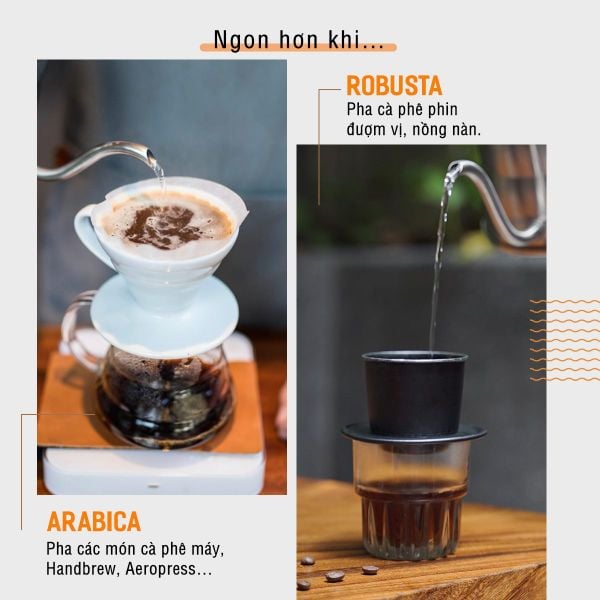
The chemical composition of coffee beans such as the amount of oil, sugar and acid in the coffee beans will be the main factors to determine the flavor of the coffee you are drinking.
Specifically, Arabica contains 15-17% oil and 6-9% sugar, much higher than Robusta. Therefore, a cup of coffee from Arabica beans will have a sweeter taste and more complex layers of flavor with a smoother texture. The amount of sugar in Arabica beans will also break down when roasted, creating a slightly sour compound for the cup of coffee, although in fact the amount of acid in Arabica beans is less than Robusta beans.
On the other hand, Robusta contains 3-7% sugar, 1.7-4% caffeine (twice the amount of caffeine in Arabica). Therefore, the flavor of a cup of Robusta coffee will be stronger, more bitter and somewhat "rough" compared to a cup of Arabica coffee. However, Robusta contains only 10-12% less oil, which gives Robusta coffee a thicker and smoother crema.
Does that mean Arabica is of higher quality than Robusta?
Not necessarily! Robusta is a great choice when you need a little extra “kick” in your morning coffee. Take a cappuccino for example, the richness and robustness of Robusta will really shine against the creamy, sweet milk of the cappuccino. Even in Italy, the birthplace of espresso, people have a tradition of blending Robusta with Arabica to stabilize the coffee flavor and create a thick, smooth crema.
How to Mix Robusta and Arabica Coffee
Each type of coffee bean has a different flavor, if you know how to mix, the flavor will become more unique, different and novel. To mix coffee, you need to prepare 3 types of coffee beans including: Robusta, Arabica, and neutral coffee beans between the above 2 types. Depending on the flavor and taste of the customer, you choose the appropriate mixing ratio. You can apply the ratio of 70: 30 or 30: 40: 30.
- The ratio of 70% Arabica: 30% Robusta will make the coffee have a balanced taste, mild bitterness, and a sour aftertaste.
- The ratio of 70% Robusta: 30% Arabica will make the coffee taste moderately bitter and slightly sour.
- The ratio of 80% Arabica: 20% Robusta tends to have a sour taste and a slightly bitter taste.
– With the ratio of 30% Arabica: 40% Robusta: 30% neutral coffee, the coffee flavor will be rich, harmonious and new.
With the way to distinguish Arabica and Robusta coffee that STV shares, we hope you will collect a lot of useful knowledge and serve your brewing work well.


 0902376267